What Is Hansa Teutonica?
Hansa Teutonica is a strategy board game by Andreas Steding, set in the medieval trading world of the Hanseatic League. You play as a merchant guild expanding your network of trading posts across northern Europe, competing with 1–4 other players for control of lucrative routes, powerful cities, and scarce upgrade opportunities.
The game is widely regarded as one of the finest examples of the Euro-style board game: elegant rules, meaningful decisions on every turn, and a satisfying tension between your own plans and everyone else's. It plays in about 60–90 minutes and rewards both careful long-term strategy and opportunistic play.
Hansa Teutonica Online is the officially licensed free digital version — you can play a solo game right now, no account required.
The Board: Routes, Cities, and Offices
The map shows a network of German cities connected by routes. Each route has a series of connection points — small spaces where you place your tradesmen (traders are wooden cubes; merchants are wooden discs).
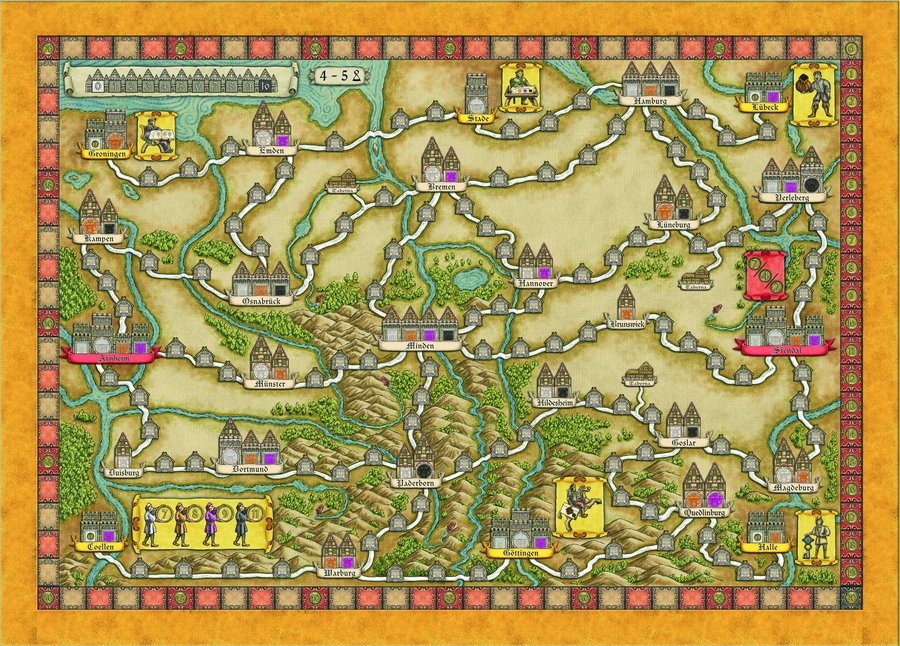
The base game board, showing cities, routes, and connection points
When you fill all the connection points on a route, you can create a trade route — this is a separate action you take explicitly. When you do, your tradesmen are removed from those points and you place one trading post in a city at either end of the route.
Cities have colour-coded office slots — white, orange, pink, and black — where trading posts go. Your Privilege ability determines which colour spaces you can occupy: everyone starts at white (the lowest), and must develop Privilege to claim orange, pink, or black offices. The colour is what matters, not a point value on the slot itself.
On Your Turn
Each turn you take a number of actions (2 by default, up to 5 if you've developed your Actions ability). The five actions available are:
- Income (A) — hire tradesmen from the general stock into your personal supply, ready to place. How many you can hire depends on your Bank ability (3, 5, 7, or all).
- Place a tradesman (B) — put one tradesman from your personal supply onto any free connection point on the board.
- Displace a rival (C) — remove an opponent's tradesman from a connection point, replace it with one of yours, and pay the extra cost to the general stock (1 for a cube, 2 for a disc).
- Move tradesmen (D) — shift your own tradesmen already on the board. How many you can move depends on your Book of Knowledge ability.
- Create a trade route (E) — when all connection points on a route are yours, spend this action to formally claim it, score city control points, and establish a trading post (or develop an ability in certain cities).
Actions can be taken in any order and repeated. You must finish one action fully before starting another.
The Five Abilities
Each player has a personal writing desk (player board) that tracks five abilities. Developing an ability costs tradesmen from the board and reveals the next (higher) level. These are what separate a mediocre player from a great one.
You develop an ability by placing a trading post in one of the five special cities (Groningen, Stade, Lübeck, Göttingen, Halle) that show an ability pictogram — instead of taking a normal post placement, you remove a tradesman from your writing desk and advance that track.
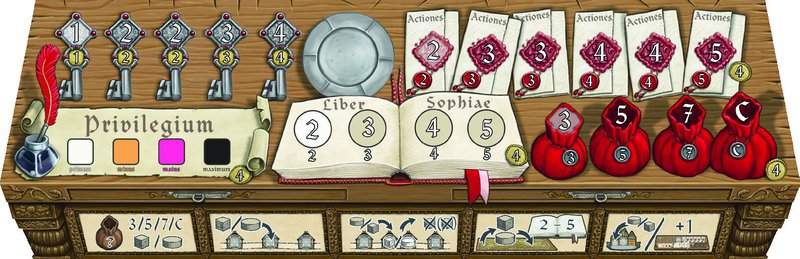
Each player's writing desk tracks their five ability levels
How Scoring Works
Points (called prestige points) accumulate live during the game and are tallied finally at the end.
- City control (live): When you create a trade route, the player with the most trading posts in each end-city controls it and scores 1 prestige point. If one player controls both cities, they score 2. Ties go to the player in the highest-colour office.
- Coellen: If you complete the Coellen–Warburg route, instead of a normal post you may place a merchant on one of Coellen's four special spaces (7, 8, 9, or 11 points). Your Privilege level must match the colour of that space. These are the highest single scores on the board.
- End-game — abilities: 4 prestige points for each fully developed ability (except City Keys).
- End-game — city control: 2 prestige points for each city where you have the most trading posts.
- End-game — network: Find your largest connected network of cities where you have at least one post. Multiply the total posts in that network by your City Keys value.
Tips for Your First Game
With the fundamentals covered, here's practical advice to help you not come last in your debut:
1. Develop Actions early
The single biggest lever in the early game is the Actions ability. Going from 2 actions per turn to 3 is enormous — you place 50% more tradesmen per turn. If you can develop Actions without too much detour, it's almost always worth doing early.
2. Don't overextend on the board
Beginners often spread tradesmen across six routes at once. This looks active but often means you never finish anything. Pick one or two routes, complete them, score your city control points, and repeat. A completed route is worth more than five half-finished ones.
3. Watch what others are developing
If two players are both racing toward the high-colour Coellen spaces, that's a race you might want to join — or deliberately block by developing your own Privilege first. Noticing what your opponents need is as important as knowing what you need.
4. Use displacement sparingly
Displacing costs extra tradesmen that go to the general stock — and your opponent gets bonus pieces placed on adjacent routes. This is often worth it to finish a nearly-complete route, but wasteful as a pure offensive move when you're behind. Use it to close out routes, not to harass.
5. Think about end-game triggers
Keep an eye on the score track and the Completed Cities marker. If you're comfortably ahead, don't rush — every extra turn is a chance for opponents to catch up. If you're trailing, play faster and take more risks. The player who controls the pace of the game often controls the outcome.
Ready to Play?
The best way to learn Hansa Teutonica is to play it. A solo game against AI opponents takes about 20 minutes and is a perfect sandbox to try out the mechanics. You don't need an account — just click and play.
For a deeper reference — rules for every city bonus, all the board variants, the scoring system in full detail — see the full rules guide.